

The results released on November 4, 2026, indicated a crushing defeat for Republicans in the midterm elections. According to the latest vote counts, Democrats have secured a Senate majority with 56 seats, while Republicans have won 44. In the House of Representatives, Democrats have so far won 254 seats, compared with 169 for Republicans. Final projections suggest that Democrats will hold 259 seats and Republicans 176. In the gubernatorial elections, Democrats have also won all seven swing states: Texas, Georgia, Ohio, Iowa, Nevada, Alaska and Kansas.
Democratic victories in several conservative and traditionally Republican states have raised the question of whether changing American attitudes toward U.S. relations with Israel played a role in the Republican defeat. In recent years, particularly following Israel’s aggressive and expansionist policies and the genocide of Palestinians, criticism of Israel and its lobbying organizations in Washington has become increasingly widespread in American public discourse. A significant share of this criticism has come from Republican and conservative political figures and activists. This may partly explain why voters in some conservative states shifted toward Democratic candidates.
The significance of this issue becomes even clearer when considering data from AIPAC Tracker and WhoFundsMyRep, which indicate that 143 of the victorious Democratic candidates for the House of Representatives received no money from the Israel lobby. Three Democratic Senate candidates—Abdul El-Sayed of Michigan, Jeff Merkley of Oregon, and Adam Hamilton of Kansas—also defeated their opponents without receiving money from the Israel lobby. Drawing on election results and pre- and post-election surveys, this article examines the role of U.S. relations with Israel in the Republican defeat.
The Broader Trend in American Society: Increasingly Negative Attitudes Toward Israel
The U.S. midterm elections took place at a time when Israel’s popularity among Americans had fallen to one of its lowest levels on record. Before 2022, Americans generally held favorable views of Israel. According to historical survey data published by the Chicago Council on Global Affairs in July 2026,[1] 61 percent of Americans viewed Israel favorably in 1978. Despite some fluctuations, that figure stood at 58 percent in 2022. Until 2000, there was little difference between the attitudes of Republicans, Democrats, and independents. After that, Democratic and independent attitudes remained relatively stable, while Republican views of Israel became considerably more favorable (see chart below).
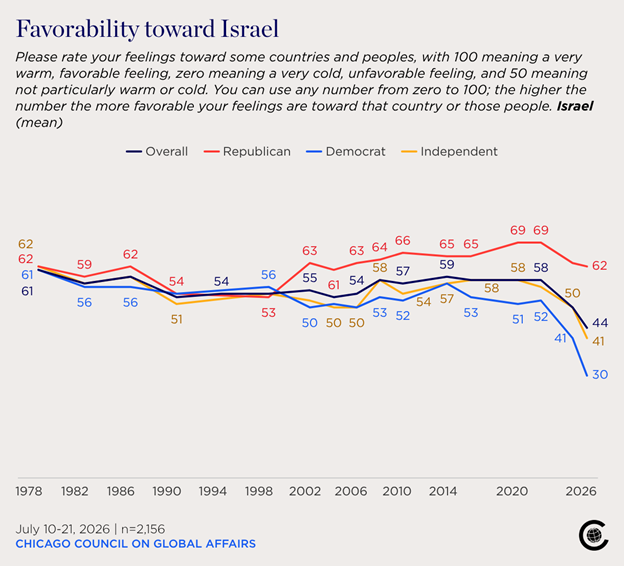
After 2022, attitudes toward Israel became markedly more negative among voters in all three groups. The proportion holding favorable views of Israel declined from 69 to 62 percent among Republicans, from 58 to 44 percent among independents, and from 52 to 30 percent among Democrats. Much of this shift can be attributed to developments following October 7. An August 2025 survey by the University of Maryland also found that nearly half of Americans believed Israel had committed genocide or war crimes during the Gaza war.[2] Data from the Pew Research Center further show that, since 2022, the share of Americans expressing favorable views of Palestinians has increased from 39 to 44 percent. Over the same period, the proportion expressing favorable views of Israelis has fallen from 67 to 52 percent.[3]
The connection between the Gaza war and Israel’s declining popularity among Republicans, Democrats, and independents can be explained in different ways. Among some American conservatives, criticism has centered on two issues: the condemnation of war crimes and genocide on the basis of Christian beliefs, and objections to the treatment of Palestinian Christians and attacks on their churches. Conservative media figures such as Tucker Carlson,[4] Candace Owens,[5] and Nick Fuentes[6] have repeatedly addressed these issues. Among some independents and Republicans who take a more nationalist approach to foreign policy, a recurring criticism is that the Israel lobby is drawing the United States into endless wars and that Washington should disengage from the Palestinian issue. Among Democratic voters, human rights and Palestinian rights feature more prominently.
The Impact of Relations with Israel on the Republican Defeat
An examination of exit polls and other surveys indicates that relations with Israel played a definite but limited role in the Republican defeat. Economic concerns were a more significant factor in pushing independent voters toward the Democrats, but relations with Israel also influenced their choices in certain respects.
According to the NBC News exit poll, the economy, cited by 39 percent of voters, and concerns about the state of democracy, cited by 33 percent, were the most important issues for American voters in the midterm elections. Majorities in both groups—52 and 79 percent, respectively—voted for Democratic candidates. Responses to other questions in the survey help clarify what specifically concerned voters about these issues. For example, rising fuel prices and the consequences of the U.S. tariff war were both sources of concern, and majorities of voters in both groups supported Democratic candidates. Eighty-seven percent of voters said they were somewhat or extremely concerned about rising fuel prices. Of those voters, 58 percent voted for Democrats.
While the economy and the state of democracy topped voters’ priorities, foreign policy was a priority for far fewer Americans. Only 4 percent of voters identified foreign policy as the most important issue. Among this group, 47 percent voted for Democratic candidates and 51 percent for Republicans. These figures indicate that although American public attitudes toward relations with Israel have become more negative, the issue is still not a leading priority for voters.
Nevertheless, as noted earlier, the negative impact of relations with Israel on the midterm election results was definite, despite its limited scope. Among which segments of American society was this effect visible? Exit polls at both the national and state levels reveal a particular voting pattern: some conservative and Republican voters supported Democratic or independent candidates. When supporters of a party vote for a candidate outside that party, the behavior is known as party defection. For example, in Texas, a relatively conservative swing state, 11 percent of Republican voters supported Democratic candidate James Talarico. The rate of party defection among Texas Republicans was approximately ten times that of Democrats in the state. Nationally, 6 percent of Republican voters supported Democratic candidates, three times the defection rate among Democratic voters. Republican defections were so pronounced that even Ted Cruz referred to them in a post on X.[7]
Relations with Israel as a Cause of Republican Party Defection
The figures indicate that a significant share of Republican party defections stemmed from the United States’ special relationship with Israel. According to an Associated Press survey, younger Republican voters were more likely than their older counterparts to believe that the United States supports Israel “too much.” Approximately half of Republican voters under the age of 30 held this view, compared with roughly one in ten Republicans aged 65 and older.[8] Overall, 20 percent of Republicans in this election said that U.S. relations with Israel were too close.[9] It can therefore be argued that growing concern over Israel caused Republicans to lose the votes of some of their traditionally loyal supporters, even though these voters constituted a minority.
Another factor worth considering is the relationship between the war with Iran, identified as the principal cause of rising fuel prices, and voters’ attitudes toward Israel. According to the NBC News poll, 63 percent of voters believed the U.S. decision to enter the war with Iran was a mistake. Of this group, 83 percent voted for Democratic candidates. To what extent do Americans hold Israel responsible for starting the war? According to a nationwide survey published by the Institute for Global Affairs in May 2026, 24 percent of Americans believed that Israel bore more responsibility for the war with Iran than any other country. Approximately one-third of Democrats and 26 percent of independents shared this view.[10]
This evidence suggests that U.S. relations with Israel made a limited but significant contribution to the Republican defeat by pushing some Republican and independent voters toward Democratic candidates. In Senate races in certain swing states, such as Mississippi and Kansas, Democratic candidates won by narrow margins. Had these Republican and independent voters supported Republican candidates instead, the gap between the parties in Senate seats would have been smaller, even if Democrats had still won. Republicans could also have won more congressional districts in the House elections.
From Electoral Defeat to Recalibrating Relations with Israel
Following the elections, this issue sparked a broad debate among Republicans over Israel’s role in the party’s defeat. In a controversial article that Trump unexpectedly endorsed, JD Vance identified U.S. relations with Israel as one of the factors behind the defeat. The Wall Street Journal[11] and figures such as Mark Levin[12] responded to his position. Representative Randy Fine,[13] Republican Senators John Cornyn and Thom Tillis,[14] and U.S. Ambassador to Israel Mike Huckabee[15] also explicitly rejected Vance’s analysis. Fine even announced that, for this reason, he would not support Vance’s candidacy in the 2028 Republican primaries. This disagreement appears to reflect concerns on both sides about the party’s future. Vance’s allies fear that maintaining close ties with Israel could lead to a major defeat for Vance and the Republican Party in the presidential election. The opposing camp, meanwhile, worries that figures such as Vance will contribute to the spread of increasingly critical views of Israel.
Ultimately, the issue of the Israel lobby cannot be considered the principal cause of the Republican defeat. Dissatisfaction with economic conditions and concerns about the state of liberal democracy in the United States were among voters’ main motivations. Nevertheless, three points about Israel’s impact on the Republican defeat cannot be denied. First, social trends in recent years indicate that Israel’s popularity is declining even among conservatives and Republicans. Second, relations with Israel played a significant role in shifting some Republican and independent voters toward Democratic candidates in the 2026 elections. Third, without the issue of the Israel lobby, Republicans would probably have been able to win more swing states and competitive congressional districts, despite losing to the Democrats overall. For this reason, relations with Israel have become a source of disagreement among factions within the Republican Party. New conservatives such as Vance are calling for a recalibration of relations with Israel to prevent Republicans from suffering another major defeat in the 2028 elections, while neoconservatives strongly support the current state of relations between Washington and Tel Aviv.
References
[2] https://sadat.umd.edu/sites/sadat.umd.edu/files/Questionnaire%20July%20August%202025%2009122025.pdf
[5] https://podscripts.co/podcasts/candace/trump-chooses-war-and-attacks-tucker-carlson-candace-ep-201
[6] https://rumble.com/v6wwy9m-trumpepstein-debate-nick-fuentes-vs-alex-jones.html
[7] https://x.com/tedcruz/status/2118125881067487633?a=REnRXlQBk9FZsV8ctQQ&s=19
[8] https://apnews.com/article/trump-republicans-midterms-reckoning-fd3114355fa1a4fc479e5a3ae17d1445
[9] https://poll.qu.edu/poll-release?releaseid=3961
[10] https://instituteforglobalaffairs.org/2026/05/war-president-israel
[11] https://www.wsj.com/opinion/jd-vance-iran-war-2026-midterms-e3509fe1
[12] https://x.com/marklevinshow/status/2118055379276013610?a=Vz7sifzjEMHJb8_Tza4&s=19
[13] https://www.jpost.com/international/article-914278?utm
[14] https://jewishinsider.com/2026/11/gop-senators-skeptical-vance-midterms-iran-israel/