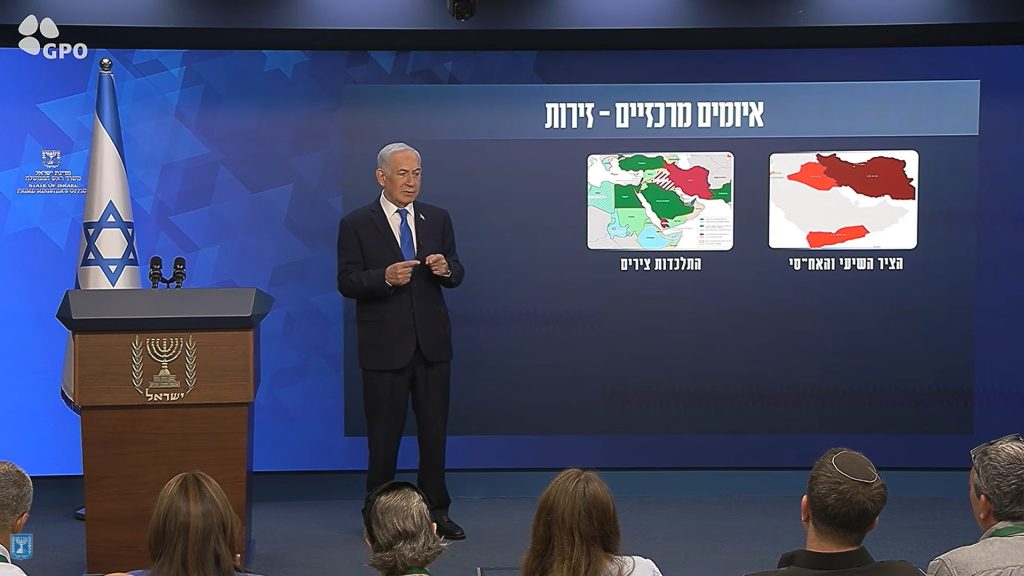
Benjamin Netanyahu, Prime Minister of Israel, in a security briefing with journalists on 18 October 2026, presented a new interpretation of the potential and actual threats against Israel. While prioritizing these threats and outlining strategies to counter them, he introduced this formulation as the new security doctrine of his government—a doctrine that is an upgraded version of the approach of previous years and incorporates developments since 7 October. In this framework, Operation Al-Aqsa Flood is regarded as a turning point in Israel’s understanding of security threats and the strategies to counter them.
Shift from Defense to Prevention
The central axis of this transformation is the shift in strategy from “containment and defense” to “prevention and offence.” In the previous version of Netanyahu’s security doctrine, threat management rested primarily on military response after an attack or an escalation of threat, preventing its expansion, intercepting attacks, and defending Israeli territory. However, after 7 October, Israel’s security establishment has adopted a more proactive approach to peripheral threats—an approach based on preventing the formation or strengthening of a threat before it becomes operational, transferring the initiative to Israel, and conducting pre-emptive strikes against emerging threats.
In fact, Israel’s strategic focus has shifted from how to repel enemy attacks to how to neutralize threats at their early stages. This transformation is not merely military; it reflects a change in the threshold for the use of force. In this conception, rather than responding to or containing threats, Israel seeks to intervene actively in the shaping of the balance of power before those threats are fully formed.
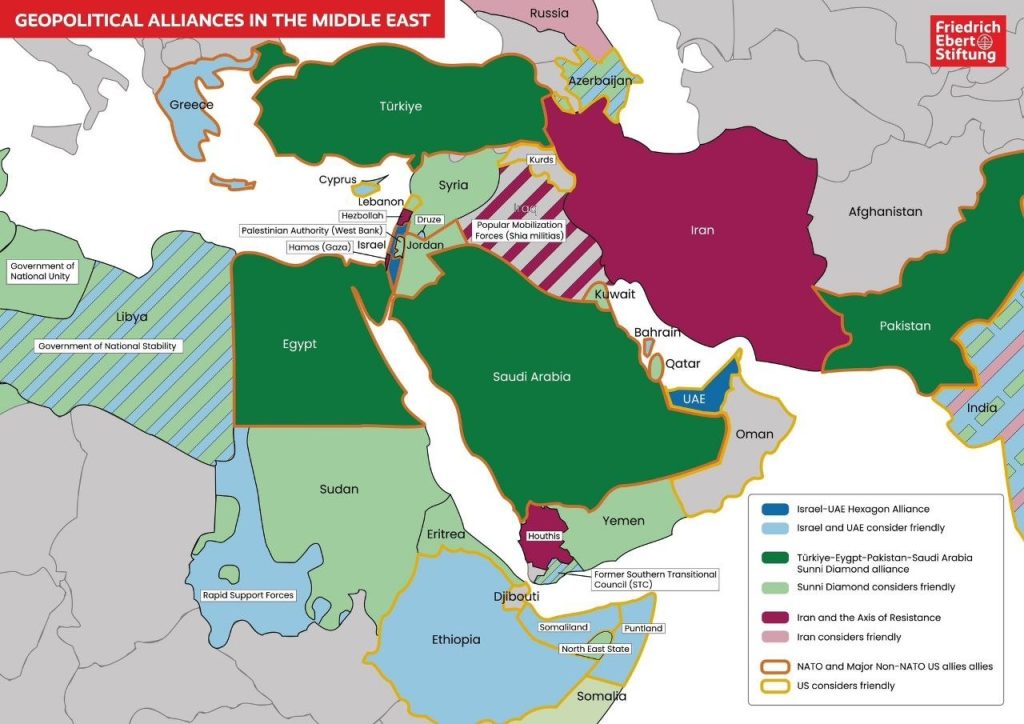
Netanyahu then, emphasizing the changing face of the Middle East, presented a map of the new regional alliance configuration, in which three main axes can be identified:
1. The Shia or Resistance Axis led by Iran: comprising the Iraqi resistance groups, Hezbollah in Lebanon, Hamas in Gaza, and Ansar Allah in Yemen.
2. The Sunni Axis: comprising Turkey, Saudi Arabia, Qatar, and Pakistan.
3. The Israel–UAE Hexagonal Axis: consisting of Israel, the UAE, and a set of like-minded countries and regional actors.
Other countries in the region are also classified among the countries friendly to or aligned with these alliance axes.
In Netanyahu’s new doctrine, Iran and the Shia axis are regarded as Israel’s primary and immediate threat. In his view, despite heavy strikes by Israel and the United States against Iran and the Axis of Resistance, this complex has been weakened but has not yet been eliminated. Netanyahu has declared the fall of the Islamic Republic regime as his ultimate objective and has emphasized his commitment to achieving it. Within this framework, Iran’s nuclear capacity and the prospect of its acquiring a nuclear weapon are presented as a strategic threat. Netanyahu has further claimed that, should Iran acquire a nuclear weapon, it would use it for antisemitic purposes.
The second axis is the Sunni axis, whose most prominent threat and leadership center Netanyahu identifies as Turkey and its President, Recep Tayyip Erdoğan. In his view, the two axes of Iran and Turkey are capable of converging and forming a joint threat against Israel. Among the regional actors associated with this axis are Qatar, Syria, Jordan, Kuwait, Libya’s Government of National Unity, Sudan’s official government, Yemen’s Presidential Leadership Council led by Rashad al-Alimi, Eritrea, and Somalia.
The third axis is Israeli–UAE cooperation, which has been elevated to a strategic level since the signing of the Abraham Accord in 2020. Netanyahu presents the UAE as the second pillar of the Israeli–Emirati order, defined in contrast to the Shia and Sunni order in the region. Among the regional actors aligned with this axis are Azerbaijan, Bahrain, the Southern Transitional Council in Yemen, the Rapid Support Forces in Sudan, Ethiopia, the self-declared state of Somaliland, the autonomous Puntland state in Somalia, the Government of National Stability affiliated with Khalifa Haftar in Libya, Greece, and Cyprus.
An examination of the interests of these actors reveals two main grounds for their convergence with the Israeli–Emirati order:
A) Separatist and irredentist tendencies
Some actors within this axis harbor separatist or irredentist tendencies. The Southern Transitional Council in Yemen, the Rapid Support Forces in Sudan, and the Haftar government in Libya are presented in this framework as actors seeking independence or secession from the central government and benefiting from the support of the Israeli–Emirati order.
Somaliland, too, declared independence decades ago, and Israel is the first state to have recognized it. In Puntland, an autonomous region in Somalia, reports have recently emerged regarding the possible strengthening of secessionist tendencies. Ehud Yaari, a research fellow at The Washington Institute for Near East Policy and a commentator for Israel’s Channel 12, has noted that the port of Bosaso in Puntland is effectively outside Mogadishu’s control and is linked to the UAE. Moreover, according to DP World’s official annual report for 2025, the company was granted a 30-year concession for the port of Bosaso in Puntland.[1] The Washington Institute also reported that the UAE has been training the region’s maritime police force since 2010—training that has been claimed to serve counter-piracy purposes and, subsequently, counter-terrorism.[2] The International Institute for Strategic Studies (IISS) has further reported that the UAE is training forces of the Jubaland regional government in southern Somalia.[3] According to Ehud Yaari, Puntland, under the leadership of Said Abdullahi Deni, has established close cooperation with the UAE and may move toward secession from Somalia should circumstances prove favorable. In addition, the HORN International Institute for Strategic Studies in Kenya, describing Puntland as a “UAE-dependent state,” has discussed the country’s influence and the prospect of expanded Israeli influence in the region.[4]
In the case of the Republic of Azerbaijan, too, its convergence with the Israeli–Emirati axis can be analyzed within the framework of the country’s irredentist tendencies. Baku can be examined on account of the territorial claims raised regarding the north-western regions of Iran with an Azeri-speaking population, as well as from the perspective of its security and military alignment with Israel and its economic, commercial, logistical, and investment convergence with the UAE. In this conception, Israel and the UAE, by supporting and reinforcing Aliyev’s territorial claims, could serve as facilitating factors for the disintegration of Iran; accordingly, the Republic of Azerbaijan’s close cooperation with this axis is interpreted within such a framework.
B) Convergence in countering Iranian influence
The second layer of convergence within the Israeli–Emirati axis can be sought in countering the regional influence of the Islamic Republic of Iran. One factor behind this convergence is the two sides’ shared concern over the spread of Islamism—a phenomenon that, in their view, could destabilize the foundations of the UAE’s political system and pave the way for currents that do not accept the existence of Israel’s colonial entity in the region.
From this perspective, the Islamic Republic of Iran’s support for Islamist movements is also regarded as one of the factors of shared concern for Israel and the UAE. Moreover, Iran’s capacity to become a dominant power in the region is a source of concern for Israel and Iran’s southern neighbor. Within the same framework, Azerbaijan’s concerns about Iran’s rise to power and the concerns of Yemeni separatist actors about Iran’s support for Ansar Allah can also be interpreted.
The Hexagon Alliance
The map Netanyahu presented at his briefing employs the concept of the “Hexagon Alliance” to describe the Israel–UAE axis. According to an analysis by the ICGS strategic studies center, this alliance delineates six geographical spheres of Emirati–Israeli cooperation, largely overlapping with the route of the IMEC corridor. These six spheres comprise India and parts of Central Asia, the Arab states of the Persian Gulf, the countries of the Horn of Africa and North Africa, the Mediterranean sphere (Greece and Cyprus), the Middle East, and the Israeli sphere. This map corresponds with the map published by the German Friedrich Ebert Foundation in May 2026, indicating that the concept has been advanced within a broader analytical framework of regional alliance configurations and geopolitical competition.
Finally, from the perspective of the Israeli regime, the Middle East will not return to the pre-7 October order, and fundamental and significant changes have occurred in the nature of threats in the region. Accordingly, Israel’s mode of confronting these threats has likewise evolved in accordance with the new regional bloc formations, comprising three principal blocs: the Shia, the Sunni, and the Israeli. However, how the new order will ultimately take shape at the end of the current regional war will depend on the strategic thinking of state officials and on the actions and resilience of the existing bloc formations.
[1] https://us-somalia.com/logistics/secondary-ports/?utm
[2] https://www.washingtoninstitute.org/policy-analysis/emirati-military-support-making-difference-somalia?utm
[3] https://www.iiss.org/publications/strategic-comments/2024/12/the-uae-as-a-security-partner-in-africa?utm
[4] https://horninstitute.org/publications/somalia-in-2026-the-elephant-in-the-room-2/?utm