Somaliland, as an exceptional region in the Horn of Africa, declared independence from the central government of Somalia in 1991 and has since sought international recognition in order to be introduced as an independent country and a member of the United Nations. This region is located in the north of Somalia and on the southern coast of the Gulf of Aden. Despite the fact that no country had recognized it until 2025, some countries entered into informal relations with Somaliland. The United Arab Emirates is one of the countries that has had informal and sometimes covert relations with Somaliland in the economic and military-security fields. Although the relations between the two sides are not pursued at the official diplomatic level, the UAE’s commercial representative office has been established in Hargeisa, the capital of Somaliland’s self-declared government. According to a report by the Emirati newspaper Al-Bayan, this office was established in Hargeisa in March 2018, and Mohammed Abdullah Al-Naqbi presented his credentials to the president of Somaliland as the director of this office.[1]
Somaliland and the UAE’s Grand Strategy
The importance of Somaliland to the United Arab Emirates stems from this country’s grand strategy regarding the control of the regions vital pathways. Therefore, by initiating informal cooperation with Somaliland, it sought to control Somaliland’s important and vital port, namely the Port of Berbera. The location of this port has paved the way for completing the puzzle of the UAE’s port strategy and is also an important infrastructure for dominating the Red Sea and the Bab al-Mandab Strait. The strategic importance of this port for the UAE, in addition to establishing dominance over one of the world’s important maritime passages through which about 60 percent of Europe’s energy and part of America’s energy and 15 percent of total global trade pass, is the creation of a new base of influence for the UAE.[2]
The importance of the UAE’s control over this port increased further when, during the tensions between Saudi and Emirati mercenaries in December 2025, a significant portion of the UAE’s influence in southern Yemen, especially in the cities of Aden and Al-Mokha, collapsed. On the other hand, after the fall of Al-Mokha and the eastern coasts by Ansarullah, the importance of this port for the UAE increased. In such circumstances, having a base overlooking the Bab al-Mandab Strait and the western coast of the Red Sea is very vital for the puzzle of the UAE’s port strategy.
Emirati ventures in Somaliland
In the field of investment and economic activities of the UAE in Somaliland, the Africa Center for Strategic Studies, in a detailed report, has examined the volume and instances of the UAE’s investments and commercial and economic interactions in this self-declared state. The UAE’s investments are mainly concentrated on the Port of Berbera and its surrounding areas; a port for whose operation DP World has obtained a 30-year concession. Under the port concession agreement, DP World has committed to investing $442 million for the modernization and management of the Port of Berbera and holds 51 percent of the shares of this project.[3] Alongside this port investment, the UAE is pursuing measures to improve supporting infrastructure, including upgrading the road network and facilitating the port’s connection to solar energy. The UAE’s economic activities are not limited to the transportation and energy sectors. This country has also acquired lands in Somaliland with the aim of developing agricultural activities in order to implement a project known as the Banana Belt. Alongside this economic presence, the UAE has also sought to strengthen security cooperation with Somaliland. This cooperation also includes access to the Berbera naval base and airport; a matter that shows that the UAE’s presence in this region, in addition to commercial and infrastructural dimensions, also possesses security and strategic components.[4]
Also, some reports indicate that the UAE’s influence in Somaliland is not limited to the field of economic and infrastructural investments. The UAE has also entered into the areas of educating students, training police forces and military forces, as well as providing financial support to them, which is indicative of the UAE’s long-term view toward investment in Somaliland.[5]
Disputes between the UAE and Somalia
The totality of these measures has raised serious concerns for the Somali government and has caused the Somali government to express its dissatisfaction to the UAE and declare these agreements annulled; of course, the Mogadishu government has lacked and continues to lack the necessary capability to influence the decisions of Somaliland’s self-declared government. After Israel, in December 2025, officially became the first UN member state to accept Somaliland’s independence, Somalia-UAE relations also became severely strained, because the Somali government believed that the brokering of this development for Israel had been carried out by the UAE. Immediately after this development, the Somali government suspended all of its treaties with the UAE government.
On the other hand, in 2024, the Ethiopian government also obtained permission from Somaliland’s self-declared government to establish a naval base along the coastline of the Gulf of Aden, on the condition of recognizing Somaliland; however, none of the two sides’ measures have yet reached the implementation stage. According to the Somali government, this measure was the starting point of the strain in Somalia-UAE relations, because the Somali government believes that this agreement is also supported by the UAE. Also, in January 2026, the Somali government accused the UAE of having smuggled Aidarus al-Zubaidi, the leader of Yemeni separatists (supported by the UAE), across the Somali border to the UAE without the Somali government’s permission, after Saudi attacks on the positions of the Southern Transitional Council. Although the UAE did not show any reaction, a week after this claim was raised, the Saudi-led coalition claimed that al-Zubaidi had been transferred via the Port of Aden to the Port of Berbera and from there had fled to Abu Dhabi by a cargo plane via Mogadishu and accompanied by Emirati officers.[6]
Recognition of Somaliland by Israel
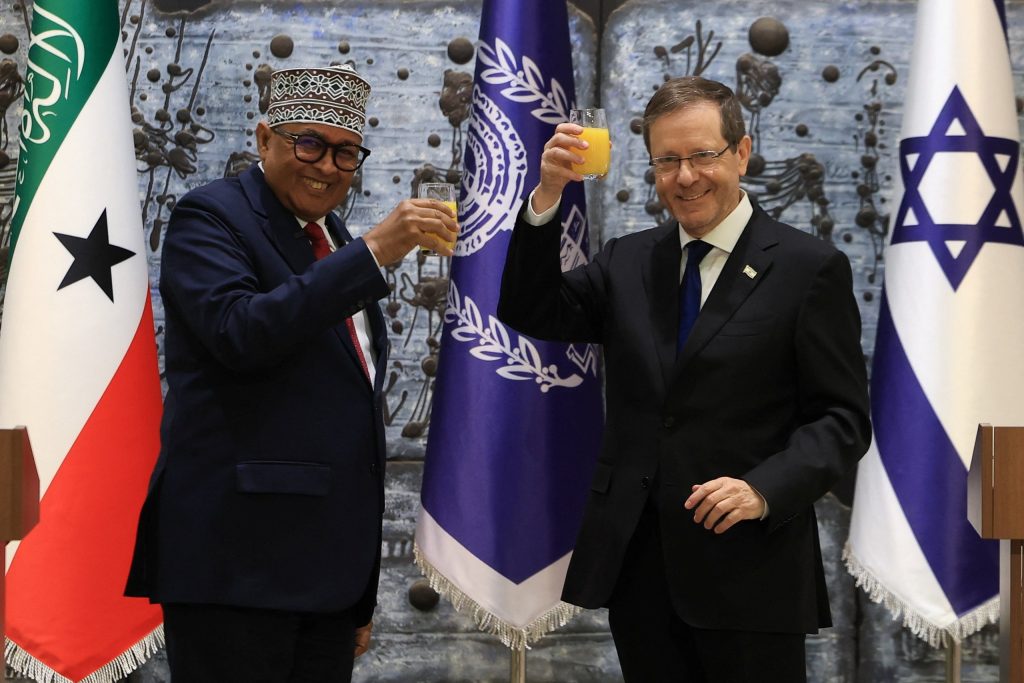
Another important actor in Somaliland is the Zionist regime. In December 2025, Israel was the first UN member to recognize Somaliland’s independence, and the Israeli prime minister was the first person to officially make a diplomatic trip to Somaliland and meet with its officials. Also, Israel’s Channel 12 announced that during October 2026, the president of Somaliland had several secret trips and meetings with Israeli officials, including Netanyahu, the prime minister, Defense Minister Israel Katz, and the then head of Mossad, David Barnea. According to analysts, the most important factor that pushed Israel in this direction is Somaliland’s important position in the Red Sea and its dominance over Bab al-Mandab and navigation in the Red Sea, which directly affects Israel’s political, economic, and security objectives. Israel is connected to the Red Sea through the Gulf of Aqaba and the Strait of Tiran, which could be a lower-cost corridor than the Cape of Good Hope route for connection to East Asia. Currently, a quarter of Israel’s exports and imports are carried out through Asia, which is precisely what makes the safety and freedom of navigation in the Red Sea and the Bab al-Mandab Strait of economic importance and, consequently, security importance.
The UAE facilitating for Israel
On the other hand, the Port of Berbera and the self-declared state of Somaliland have an excellent position in southern Yemen that can facilitate military operations against Ansarullah (one of the components of the Iran-supported front). It can also provide a new gateway for Israel’s activism in African developments, especially in the Horn of Africa and North Africa. Israel’s security activism and its security networking in Africa are linked to developments in Libya, Sudan, Eritrea, Djibouti, and Somalia, and it has close strategic relations with Egypt, Morocco, Ethiopia, and Kenya. For the first time in 2026, the French news agency Le Monde announced that, according to an examination of satellite images, the UAE is developing facilities with military applications in Berbera that may also be used for Israeli military purposes. Sometime later, during the president of Somaliland’s trip to Israel in June 2026, he did not rule out the possibility of American and Israeli access to military bases in Berbera.[7] Also, in July 2026, Somaliland’s defense minister announced that the police and military forces of this self-declared state are being trained by Israeli military forces.[8]
Ultimately, the United Arab Emirates has defined an active presence with a long-term outlook in Somaliland in its strategy through a half-billion-dollar investment and is increasing its influence in this region; however, the UAE has still not recognized the independence of this region. Also, on the other hand, the provision of Berbera’s infrastructure by the UAE has practically facilitated the conditions for Israel’s security activism in the Horn of Africa, and public reports also indicate the possibility of an increase in Israel’s security presence in the region. With the conditions for Israel’s influence being provided through the development of the port and military infrastructure of the Port of Berbera by the UAE, the UAE-Israel measures in the region can secure the following interests for this bloc:
- Increasing oversight of commercial transportation in the Red Sea and the Bab al-Mandab Strait
- Ensuring the security of Israeli and Emirati commercial ships and, consequently, reducing Israel’s logistical costs
- Providing the possibility for the UAE and Israel to confront the Ansarullah movement in northern and western Yemen
[1] https://www.albayan.ae/economy/local-market/2018-09-23-1.3363932
[2] https://journals.abru.ac.ir/article_721705.html
[3] https://africacenter.org/spotlight/gulf-state-actors-east-africa/
[4] https://journals.abru.ac.ir/article_721705.html
[5] https://www.ispionline.it/en/publication/the-uaes-rising-military-role-in-africa-defending-interests-advancing-influence-172825?utm
[6] https://parsi.euronews.com/2025/12/27/why-israel-recogniz-somaliland-dubowitz-said-dont-make-fun-look-at-the-map?utm
[7] https://www.lemonde.fr/en/le-monde-africa/article/2026/07/06/uae-discreetly-builds-military-base-in-somaliland-for-us-and-israel_6755184_124.html?utm
[8] https://www.investing.com/news/world-news/somaliland-receiving-israeli-military-training-but-not-in-talks-for-base-minister-says-4747591?utm